The Economics of AI: The Unit Price of Intelligence
The price elasticity of artificial intelligence, where the unit cost of tokens has plummeted by over 90% while total enterprise spending and capital investment continue to surge.
AUG 03, 2026
AI token costs are falling fast and even as the price per unit drops, total enterprise spending is going up. This isn’t a contradiction. It happens because of price elasticity and growing demand. As AI becomes cheaper and more powerful, companies find more ways to use it, making “tokens” a new kind of business currency.
What Is a Token, and How Is It Priced?
Before unpacking the spending paradox, it helps to define the unit everyone is now budgeting around. As Madeline Mitchell Stacy explains in her Substack article “Tokens – The Currency of the AI Era” (2026): profmitchellstacy.substack
“Token pricing – or sometimes known as metered pricing – includes both input and output of the model. Tokens are the basic unit of measurement in AI computing. According to NVIDIA CEO Jensen Huang, AI tokens are a new, fundamental market category and a primary unit of economic output” (Stacy, 2026).
Large language models (LLMs) break text into smaller pieces called tokens before processing it. This process is known as tokenization. A token might be a whole word, part of a word, a punctuation mark, or even a space. In English, one token is about four characters, or roughly three-quarters of a word on average. Different AI labs use their own algorithms to tokenize text. profmitchellstacy.substack
Importantly, output tokens usually cost more than input tokens because generating text takes much more computing power than reading it. This difference is important: a simple conversation might cost just a fraction of a cent, but longer, more complex tasks that generate many output tokens can be much more expensive. That’s why quoting a single “per-million-token” price can be misleading unless input and output costs are listed separately. profmitchellstacy.substack
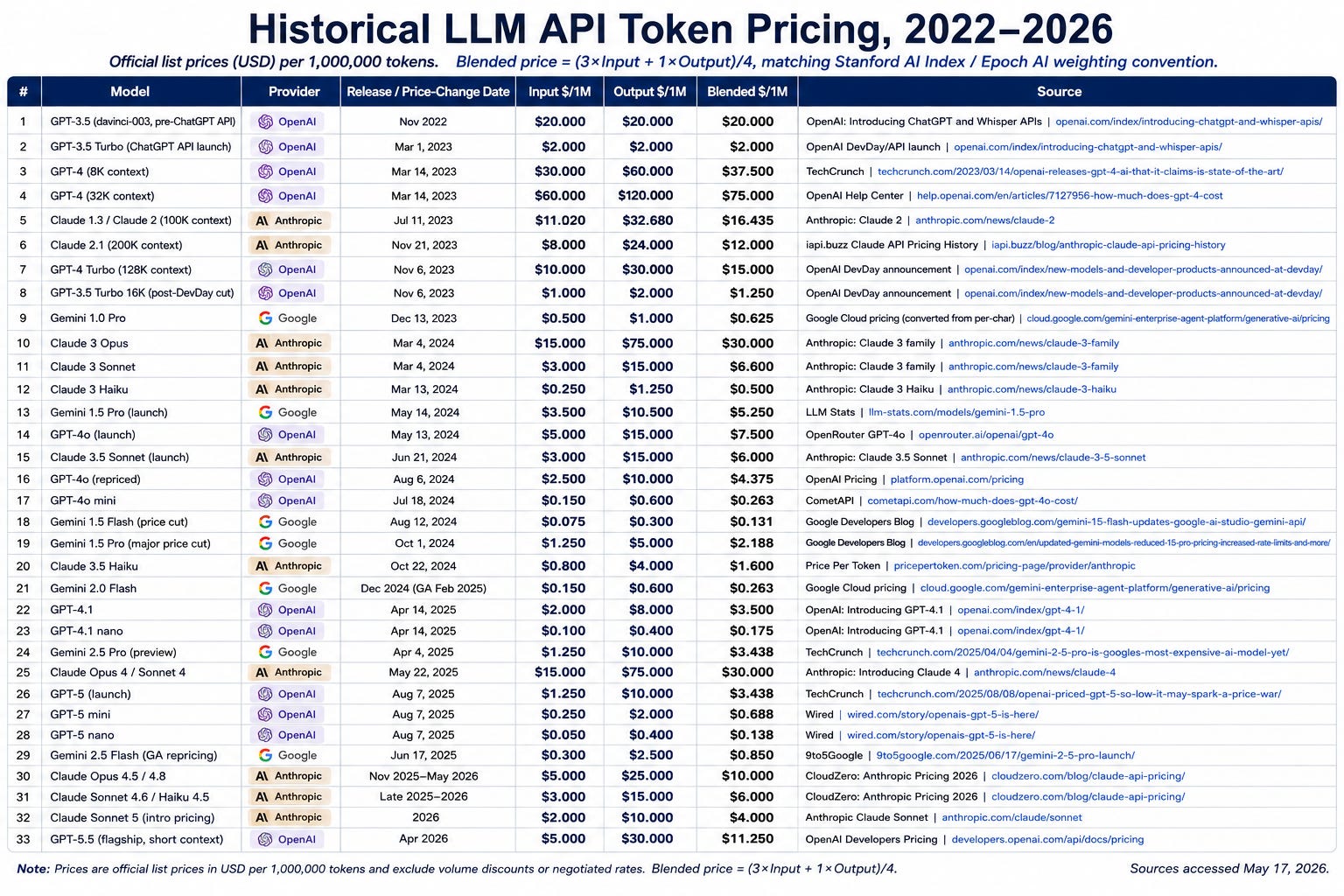
If you look at the GPT-3.5-Turbo to Gemini-1.5-Flash row, you’ll see the “99% discount”: reaching GPT-3.5-level performance (a 64.8 score on the MMLU benchmark) dropped from $20 per million tokens in November 2022 to $0.07 by October 2024.
That’s roughly a 99.65%, reduction in just 18 months (Stanford HAI). But if you check the GPT-5 to GPT-5.5 row, flagship list prices are going up, not down, because each new generation aims for higher capability.
Both trends are real and happening at the same time. In the past, a steep discount on a key input usually meant real savings for a company.
Today, even as token prices collapse, corporate AI budgets are higher than ever. Goldman Sachs now projects combined capital expenditure of $5.3 trillion for Meta, Microsoft, Amazon, and Alphabet between fiscal years 2025 and 2030, up from a prior estimate of $4.5 trillion (Business Insider).
This is a real turning point for the economy. Intelligence is almost free per unit, but the cost to use it across a business has never been higher. Instead of saving money, companies are actually spending more overall.
These four companies alone are on track to spend roughly $725 billion on AI infrastructure in 2026 — a 77% jump over 2025’s $410 billion — with the broader set of five leading hyperscalers projected near $600–650 billion for the year (Business Insider; CreditSights).
Why Is This Happening?
There are two main forces at work:
1. Hardware gains and simpler, more efficient models have driven the per-token price down sharply. Compute needed to reach a given performance level has been halving roughly every 8 months (95% CI: 5–14 months) — faster than the two-year doubling cadence of Moore’s Law (Ho, Besiroglu, Erdil et al., Epoch AI).
2. As AI becomes cheaper, companies use it much more, which often cancels out or even outweighs the savings from lower unit prices. It’s important to separate the unit price for a fixed capability from the market price of a new, more advanced model. While prices for basic tasks keep dropping, top models get more expensive with each new version. For example, OpenAI launched GPT-5 in August 2025 at $1.25/$10.00 per million input/output tokens, and then GPT-5.5 in 2026 at $5.00/$30.00 (OpenAI; OpenAI Developers pricing).
Instead of just lowering prices, both providers and customers are using these gains to buy or offer more powerful models. Economists have a name for this pattern: it’s a modern example of the Jevons Paradox.
In 1865, William Stanley Jevons noticed that more fuel-efficient steam engines actually increased total coal use, because efficiency made coal useful in more ways. The same thing is happening now. Cheaper tokens aren’t just used more for current tasks they are also making new uses possible. Total spending increases only if the demand is elastic if the percentage increase in tokens used is larger than the percentage drop in price.
Goldman Sachs Research predicts that token use will grow 24 times by 2030, reaching about 120 quadrillion tokens per month. This growth is mostly due to the spread of agentic technology, not just price elasticity (Goldman Sachs).
The need for tokens depends on the business results AI can deliver and how easily AI can replace other resources. That’s why “tokens per employee” is now a real business metric. As tools get cheaper, companies find more ways to use them, spreading AI across the organization and raising total spending even as the price per token drops.
The API bill is just one part of an AI system’s total cost. Industry studies show a similar pattern: model and technology costs usually make up only 30–40% of the total AI project budget. The other 60–70% goes to integration, data preparation, training, and change management (Teamvoy, 2026 AI Implementation Cost report).
Uber’s experience illustrates how quickly this can spiral: the company burned through its entire 2026 AI budget in just four months after Claude Code adoption jumped from 32% to 84% of its roughly 5,000 engineers, prompting its leadership to question whether the spending was delivering proportional value (Fortune).
Uber is far from alone: a 2025 survey of 372 companies by Mavvrik and Benchmarkit found that 85% of organizations miss their AI cost forecasts by more than 10%, and roughly one in four miss by more than 50% (Mavvrik & Benchmarkit, State of AI Cost Governance report). Market prices, on the other hand, depend on product positioning, competition, premium features, and how often new models are launched. Firms ought to consider separating the cost of reaching a certain level of capability from the market price of the latest model.
An Illustrative Enterprise Pricing Scenario
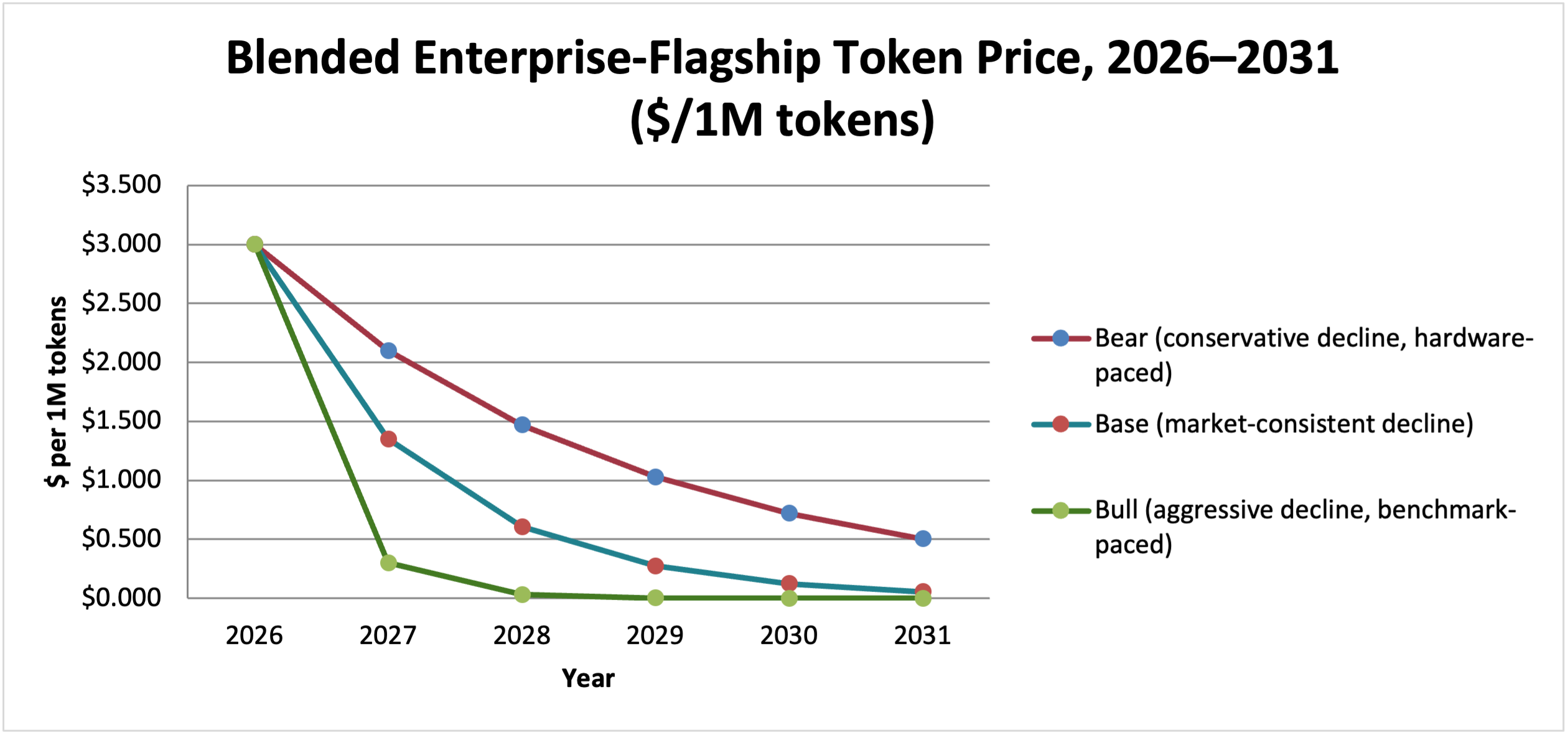
As a planning example (not an outside forecast), imagine an enterprise flagship model starts at $3 per million tokens in 2026 and drops each year by 30%, 55%, or 90% in bear, base, and bull scenarios. In the base case, the price would be about $0.055 by 2031. Still, this drop in unit price doesn’t mean enterprise AI budgets will fall by the same amount.
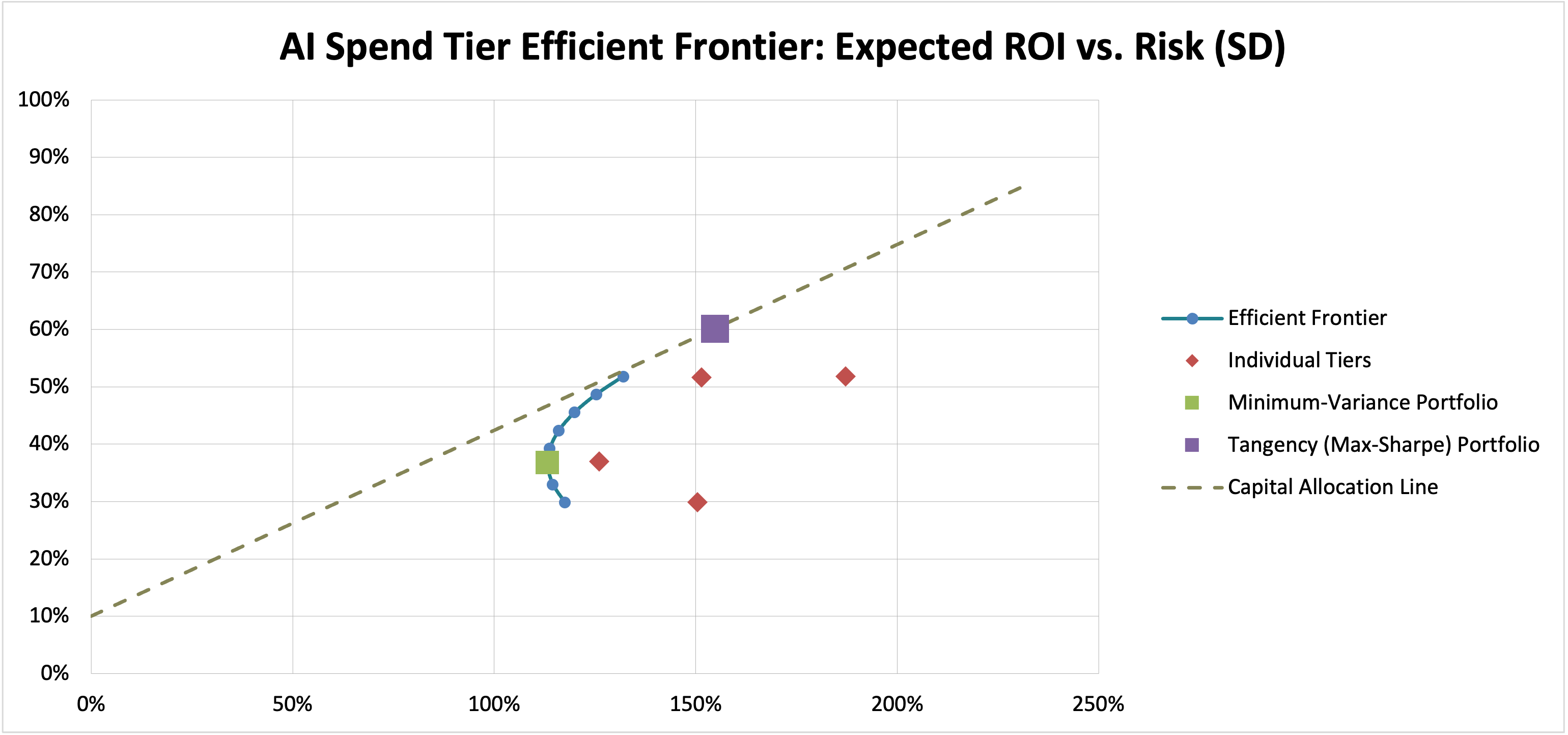
The relevant managerial metric is not token price alone but the cost of achieving a defined business outcome.
Firms should therefore monitor effective price by capability level, token volume, complementary implementation costs, and outcome-level returns. Lower unit costs can expand total AI expenditure when demand for AI-enabled tasks grows more rapidly than prices fall, whether that expansion creates economic value depends on measured productivity gains rather than spending alone.
AI is getting cheaper per unit but more costly overall. This is not a contradiction. It is a demand pattern that requires careful management, and it is the Jevons Paradox at play now.
The companies that do well will be those that plan their budgets for volume, checking results, control, and combining systems.
We will dive into the next topic on the economics of Ai by looking at the Opportunity Cost Analysis of different models, and forecasting model-based tasking as an optimal AI portfolio management tool for enterprises.